
How to Fail at Being Finnish: #7
On comparisons, parenting, and green lentils + a newsletter update

Welcome to the first edition of my newsletter under its new name Winter Book.
This new name means a lot to me (it was the working title of an abandoned memoir I drafted some years ago) and I think it does a great job of summing up what this newsletter has become over the past 3 years: a document of the food I love and experiences I’ve had as a writer in one of the world’s coldest countries.
I’m really looking forward to writing this newsletter in 2026, and this new identity feels like a great place to start from.
Now for this week’s diary entry…
Wil
PS.
A note for paid subscribers: with this name change, I’ve changed payments on your bank statements to show Wil Reidie Substack from now on, not recovering line cook.
MONDAY
“Better.”
It’s a horrible word really. There’s no end to the bother it can cause. “Better” is the word that makes you compare your friend’s luxury car to the piece of junk you have rusting in the front yard.
“Better” makes you compare your job to the one you’re certain would make you that bit happier.
“Better” keeps you looking in the mirror lamenting how blancmange-y your gut has slowly become compared to the one you had in your twenties.
I wish they’d never invented the word.
But, for all its sins, at least it is only one word: better. If you’re talking English and want to compare your shitty Chinese quartz watch to your lawyer buddy’s Patek Philippe, that’s the only version you need to remember.
If, like me, you’ve decided you need to speak better Finnish, however, you need to learn all of the following.
Parempi
Paremmat
Paremman
Parempien
Parempain
Parempaa
Parempia
Paremmassa
Paremmissa
Paremmasta
Paremmista
Parempaan
Parempiin
Paremmalla
Paremmilla
Paremmalta
Paremmilta
Paremmalle
Paremmille
Parempana
Parempina
Paremmaksi
Paremmiksi
Paremmatta
Paremmitta
Paremmin
Parempine
I think half the struggle I have learning Finnish is when I fall prey to this entirely unhelpful habit of comparing myself and my abilities to others. But it’s particularly on my mind today because the Finnish Adjective Comparative form, examples of which I’ve listed above for the Finnish word for “better”, is the lesson of the day.
In what I assume is an attempt to have us all better understand the true nature of this grammatical form, our teacher asks us whether comparisons are a good or bad thing.
A fellow student, a woman from India who joined weeks after the course began and yet commands a fluency I can’t help but be envious of, argues that comparisons are a great thing. They help inspire us toward better things, she suggests.
I’m jealous of how much healthier her relationship with comparison is to mine.
TUESDAY
Last week we “viewed” (I think that’s the word adults use to look at a potential house, right?) a small rivitalo (terrace house) on the other side of town. Now we have confirmation the paperwork is done, our first house as a family is almost ours.
No more apartment neighbours smoking pot at 8:30am. No weird cooking smells other than my own in the hallways. No unexpected naked old men walking in on me in the shared sauna (the expected variety I will miss of course). In fact, for the first time, we will have a little sauna of our own to use as and when we please.
I don’t have a car. I don’t have an expensive watch. But I will have a sauna.
At dinner my wife, Silja, and I ask the kids (Elise, 4 and Sam, 6) how they want to decorate their rooms. They’ve shared a room up until now. Having my own space as a boy always felt absolutely necessary for me, and I’m genuinely excited they’ll have a room of their own to colour with their ever-growing personalities and passions.
Elise’s wants are perfectly true to character: her room is to be pink, glittery, and full of dragons.
Sam’s are also strangely true to form.
He wants no wallpaper.
No flashy posters or racing car bed.
What he does want, and I quote, is: “a picture of old men with beards.”
WEDNESDAY
Christmas in our corner of Finland this year was uncharacteristically warm. The tepid snow that did fall only capable of forming the loosest of grey slush on the ground. Good little Finn that she is, this was of deep disappointment to my wife who looks forward to the snow of winter as much as, say, an Englishman does the summer sun.
This week, however, much to my secret disappointment, January has seen our world turn white once again. It’s obviously no surprise that a country as cold as Finland knows how to deal with snow, but having grown up in a country where a mere inch or two could literally close school for the day, it does impress me. Once the snow is a few centimetres thick, squads of ploughs are scrambled, clearing roads first and, not very much later, the foot and cycle paths.
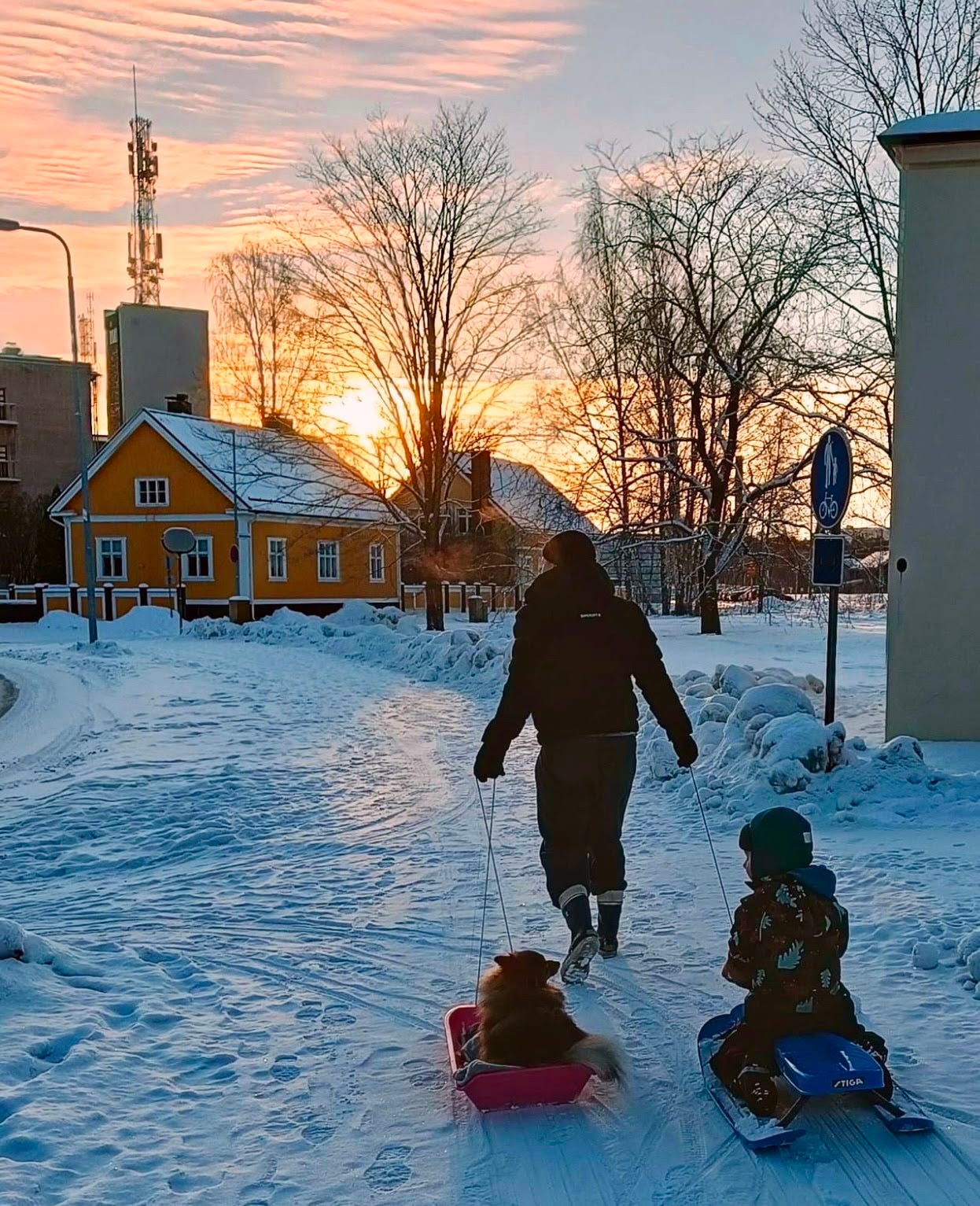
That little gap between the former and latter, however, does tend to leave the sidewalks still covered for the school run. This is why during these snowiest of days you will often see small children being casually dragged to school on sheets of hard plastic known here as pulkka.
I admit, this practice took me a lot of getting used to. You see, dragging your child in a pulkka invariably requires you to stand several feet ahead of them, often needing to cross roads with your back turned to the most precious thing in your universe. Even worse, there is no harness on a pulkka. No restraint. Nothing to stop your precious darling tipping out and languishing on the fresh snow. All that’s left to alert you to this roadside, snowy capsizing is the slow realisation, after several steps at least, that the job of dragging said child has become disconcertingly easy.
This I see for the first time from a second-person perspective on my cycle to school today.
A mother drags her young child who can’t be older than four. She is dressed in the padded jumpsuit that is the uniform of children here in winter, and their pulkka shines lurid pink against the virgin snow. The mother’s hand is stretched out behind herself, it holds the thin rope that draws the most precious thing she knows along with her. As I wait across the road from them at a set of traffic lights, said child, for no good reason, leans over the side of the shallow plastic pulkka and casually tumbles out.
One step.
Two steps.
On the third the mother stops, turns, and rushes back to the giggling infant.
THURSDAY
Making sure your kid doesn’t seriously harm itself from falling from a plastic snow carriage is, I’d rank, one of the top-line parenting jobs. The main ones. But parenting often feels like a deeply traumatic computer game that throws endless less important side quests at you in addition to the main campaign. Side quests that you end up feeling obliged to take care of lest you not “100%” the parenting game and look bad compared to all the other players mums and dads.
Sam’s pre-school is the god of all side quest-givers. They never stop. It’s relentless. Silja and I have learned to expect several messages a week in our inbox detailing a new task we need to complete.
Today’s out-of-nowhere side quest comes in anticipation of… wait for it… 100 Days of the Pre-school Academic Year.
No, I don’t know how I’d missed it either.
And how do they wish to celebrate this occasion?
By having the children bring in 100 “things” for a “100 Days of Pre-school Exhibition”.
By tomorrow morning Silja and I will have discussed whether that was a typo in their original message (Sam suggests it is not and that 100 items are indeed required), whether we can be bothered to send Sam in with a bag full of 100 little toys, or whether we are prepared to be the kind of parents that send him in with a bottle filled with 100ml of water.
FRIDAY
I wake up, take the dog for a walk, and make coffee. I then count 100 green lentils and put them in a small plastic, ziplock bag.
This is Fatherhood.
*
Dropping Sam off an hour later, I learn that I am one of two types of parent.
There are several bags full of 100 little toys, and next to them, a small bag of rice, a jar of dried beans, a cup of fusilli pasta, and a familiar bag of green lentils.
You can spend your life worrying about who has it better, who does it better. But, as my struggle to learn this language and make sense of life in Finland reminds me, life isn’t a game you can 100%. Every word you learn leads to endless others and, as the Finnish saying goes:
“‘There are many ways to do things,’ said the old woman as she wiped the table with the cat.”
All we can ever really do is pick our side quests and get on with them.
The diary will continue…
Wil Reidie’s Winter Book in 2026
This month I mark three years(!!) of this newsletter. And after far too many essays and recipes to count, I’m more excited than ever about writing this newsletter for you.
This year, as well as the monthly Nordic-inspired recipes, my How to Fail at Being Finnish diary entries, and essays, I’m also working on more ebooks for paid subscribers.
After the great feedback I got for my first ebook (which collected my most popular bun recipes) I’ve decided to create more for you, starting with an ebook that collects my most popular savoury dishes.
It will be called Exit, Pursued by a Herb-crusted Salmon, and, like the bun ebook, will be available free to paid subscribers.
If you are able to support my work here, please become a paid subscriber today, it’s just $30 a year.
Love your writing Will. Ps it’s been snowing in Upstate NY since October. ⛄️
If my child were enrolled at that school, I would have sent them off with a parcel of 100 little very angry notes.
P.S. I think your son has remarkable taste.