
How I Learned to Say "Yes, Chef."
On being a chef and a father

Happy New Year to you all! I hope you had a good one.
Just before Christmas, I published my first ebook, How to Win the Nordic Bun Wars and I want to say thanks for the kind comments (and to everyone who became paid subs) in response to it.
While looking back on the work I’ve published over the past 3 years for that ebook, I revisited an essay I wrote when the newsletter was just a few weeks old.
It’s called ‘How I Learned to Say “Yes, Chef.”’ and remains one of my favourite pieces. Now there are a few more of you here reading, I wanted to share it again.
I hope you enjoy it,
Wil
How I Learned to Say “Yes, Chef.”
Of all the things you need to survive the, frequently miserable, life of a professional cook, one thing stands out from all others. It isn’t great chopping skills, “asbestos” hands or a weirdly sensitive palate that can distinguish which hill in Sri Lanka your cinnamon comes from. What you really need is a superhuman tolerance of repetition.
You might think I’m referring to the repetition of the job itself here. The endless chopping of vegetables, for example, or having to cook the same dishes night after night. This is true as well. But it isn’t what I’m talking about.
What I’m really talking about is the repetition of jokes.
When I was a stagiaire at Portland Restaurant in London a decade ago, I would constantly hear a tall Taiwanese Sous Chef and (not so tall) Australian Chef de Partie shouting “CAMPARI” to each other in a voice that fell somewhere between Margaret Thatcher and the Mad Hatter. They’d do it hour after hour, day after day.
I spent over a year at that restaurant and those two never seemed to get bored of it.
At one of my last jobs as a line cook in Stockholm, my Head Chef never tired of adding the Vengaboys’ “We Like to Party” into the usual heavy metal Spotify playlist the crew would listen to every day.
Before his days off he would even make sure the restaurant sound system was logged in to his own account so he could add it from his bed.
And, of course, no shift was complete without someone, somewhere in the kitchen, reciting something from that Gordon Ramsey Boiling Point documentary.
If you can’t get your head around this particular flavour of repetition, then professional cooking isn’t for you.
This willingness to constantly repeat yourself is required in the way cooks communicate as well. If you walk into a professional kitchen, the thing you’ll hear, more than the same jokes even, are two simple words: “yes”, and “chef”.
Being able to say these two words potentially hundreds of times a day (definitely hundreds if the day involves a long brunch shift) is a necessity. You can’t get fed up of it, or even need to think about it. You just need to do it. Like reflex. Like breathing.
This is where the trouble began for me at the start of my cooking career.
Saying that simple phrase, the required two syllable, one-two punch “yeshef” felt like a lie. It felt like I was playing dress-up.
I was 29, making a career change from office drone to Michelin restaurant cook. The only experience of chef life I’d had was from those Gordon Ramsey documentaries and Rick Stein cooking shows I’d watched as a teenager.
And when I first walked into a professional kitchen, on some level, I just couldn’t believe that real world kitchens actually worked this way. It all seemed too much like a cliché.
And when I first uttered those two words, I did so with all the vigour of a day old soufflé.
I felt like a 10 year old version of myself again. The same 10 year old who once returned home from a weekend in Newcastle and decided to affect a Geordie accent for some reason. Before, that is, my school friends quite rightly started taking the piss out of me for it.
I felt ridiculous then. A silly little fraud.
Years later and I regret only one thing about those early days of my life as a line cook.
It’s regret for thinking of myself as a fraud for as long as I did.
I associate, rightly or wrongly, the birth of my son, Sam, with the end of my full-time restaurant career, in time. That other links exist, on other levels, between these two affairs, is not impossible.
In the years that followed, as Sam grew from a whiny, fleshy lump that expelled only endless explosions of shit, into a human that expelled words of varying sense as well, I was reminded once again of how I felt in those early cooking days of mine.
Because to say “yes, chef” without some deeply-set, unnamable hesitation would have meant believing I was actually capable of being a chef as well.
And to answer “yes, Sam” without some deeply-set, unnamable hesitation when he called me Daddy would have meant believing I really was a capable father.
I learned pretty quickly that I needed to get over myself and shout “yes, chef” with the same enthusiasm as everyone else. I did feel silly. I felt like I hadn’t earned it. But I learned to ignore my feelings and, after enough repetition, I even got used to it. It just became another word.
Eventually, once I moved to Stockholm, “yes, chef” turned into “ja, tack”.
Maybe that made it easier for me. The distance of another language.
But it wasn’t for some years that I gave myself permission to think of myself as anything other than the worst line cook in the world. Or at least the worst in the little corner of Europe I had found myself in.
I was working at a popular Stockholm restaurant located on an island to the west of the city centre one year. It was beautiful. Swans and ducks congregated at the waterfront every day in the summer. And, come autumn, the horizon beyond the water gave the perfect view of the sunset before evening service.
And it was always busy. And the work was hard. For me, almost impossibly hard.
I was a few years into my chef life by this point and all the progress I’d thought I’d made felt meaningless again.
I could never prep the industrial size quantity of mashed potato in time for lunch. I was always needing orders to be repeated when the more complicated a la carte menu was being served in the evenings. And, one particularly bad day, a sous chef even asked me if I’d cut the chives that morning with a blunt bread knife.
I’d used a 500€ Gyuto chef’s knife hand made in Japan.
The more I stressed about it, the harder I worked and obsessed over the tasks at hand, the worse I seemed to do.
The head chef was a bald, lump of a man that looked like he’d either spent time in the military or styled himself on someone who had. A lifetime of heavy whisking had rendered his right forearm twice the size of his left.
He certainly didn’t seem to have much time for me or my pitiful forearms.
After a few months on the job, he took me into the office and said he didn’t think it was working out. The summer break was a month away. He suggested we part ways at that point.
It didn’t surprise me of course. I knew it wasn’t working out. What surprised me was his telling me it was obvious to him how little I cared about the job. How little effort I was putting in. That I always had my head sunk and it was clear I had no interest in being there.
He had no idea about how much I really did care. How I was up at nights wondering how I could get a bit faster. How I might remember orders better or come up with some kind of system that might help. It was fascinating to me how my frustration was interpreted as a lack of interest. Fascinating and heartbreaking.
I’d never been so aware of how my worry and insecurity and anxiety was screwing me over than at that moment in Military Chef’s little office.
I’d failed. Good and proper. And so I promised myself then that I’d enjoy that last month. I’d make stupid jokes. I’d sing and dance during prep time and whatever the hell else I needed to do to get through the day and return to my wonderful wife who I’d just married and barely ever saw.
Not only would I not listen to what Military Chef thought of me, I’d try to stop listening to what I thought of myself as well.
This carefree confidence might not have been genuine at first, but I’d repeat the jokes and the songs in the hope that eventually, if I focused less on the fears that had been holding me back, stopped trying so hard, and just lived more in the moment, the confidence might stick.
A month later that same chef told me I’d become a different person and he asked me to stay.
He’d always been something of an arse so it felt good to turn him down.
There is a small church on the other side of the street from where I live today. It’s a modern thing, not a pretty old church or anything like that. Something from the nineties, probably.
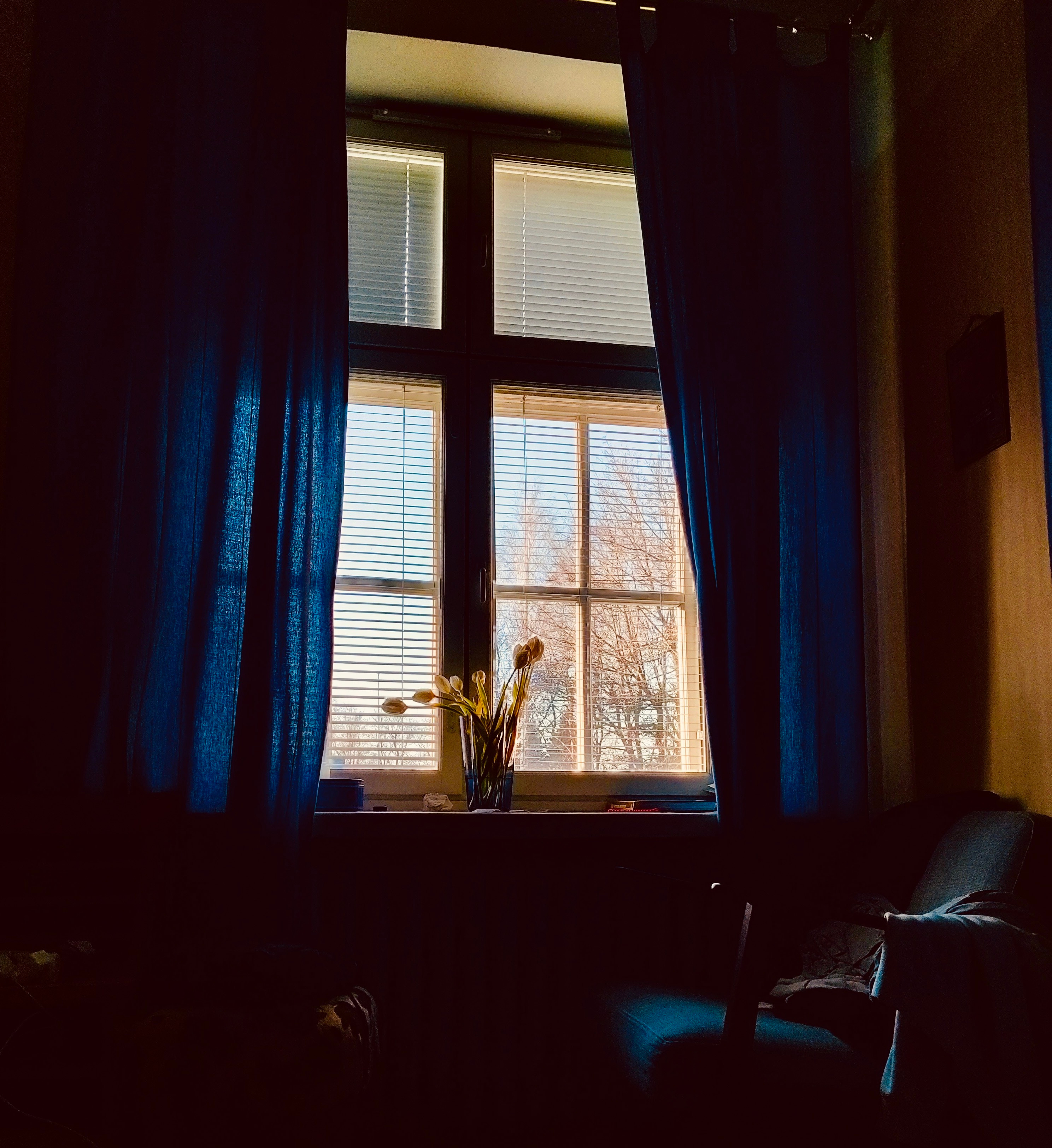
But come early spring, as the sun slowly sets behind it, the light falls at such an angle that our small home is filled with glaring rays of gold.
I always look forward to spring to see that light again.
I remember once, it’s years ago now unbelievably, my son Sam running into this living room. I remember him shielding his face from the bright reflection on the hardwood floor. I closed the blinds for him. Black lines ran along the floor.
To be with Sam, to be playing with him, to be sat with him, even to be in front of the television with him, I sometimes feel intimidated by it. Not always, only sometimes. Like the light of a particular time of year burning at a new angle through the window. I become intimidated by the responsibility of it all. Of being his father.
I know I am not the best father in the world. I know I don’t use every bit of energy I could on him. I worry the time in front of the television is too long, and the amount of time in the bath is too short.
And there is so much to worry about besides these tiny things. And one of the things I worry about is change.
Being a father, with a son so young, is to see something new every day and moment you are with them. Being a father to a son so young is to fall in love afresh everyday. Everyday there is something this tiny being has learned to do or started to do differently.
When I wake, I see him for the first time and my eyes are changed. My love for him is changed with it. I remember a time when I feared the day this love would stay the same two days running. To become ordinary, repetitive even.
Sam runs into the room, he shields his eyes from the light, but I know now I have all I need to love him and to know him.
All it takes is for me to be here for him, in this moment, today and every today.
What matters is the repetition of things, I think. Or at least repeating things the right way.
Repeating something can be an act that keeps one foot in the past and one in the present. Maybe that’s why chefs can repeat the same jokes over and over again. Though the days are long, the work painful, the same jokes help us remember when we laughed out loud the first time.
But to repeat something the right way is to give up on the past and to think only of being fully present now, in every new day and moment, toward the future.
Always being ready to try again, fail again, and fail better.
Otherwise, what you do in the present can only ever end up a watered-down approximation of something that used to be. Something not authentically you. A reflection reflected too many times.
For a long time I questioned who I thought I was, pretending to play at being a chef.
Then I stopped listening to myself, stopped trying so hard, and started simply enjoying my cooking in the moment while doing my bit to make the people around me enjoy the time we shared in the kitchen as well.
Little did I know, chefs don’t really care too much if their colleagues are the fastest in the world, can remember order tickets perfectly every time, or are even able to chop chives to microscopic accuracy. What they really want is someone fun to work alongside, someone who cares, and, maybe, someone who can repeat the same private jokes day after day after day.
For a long time I questioned who I was, calling myself a father.
But somehow I learned to stop listening to myself…
Looking back on 2025, I think my biggest achievement with this newsletter was actually writing it every week for you. Whether it was essays about Grief and The Moomins, recipes for incredible buns, or my ongoing diary of life in Finland, this newsletter is a true joy for me, but one that requires a lot of work to keep up.
If you’ve enjoyed reading The Recovering Line Cook, and want to help keep it weekly, please consider becoming a paid subscriber. It makes all the difference.
I can see why this is a favorite. Content, flow, details, lessons, beauty, the how and why- spoke to me,
Thanks for publishing
I remember reading this the first time, and I loved it even more as I read it again. I feel as though you are speaking my heart - like I could have written these very same words. Thank you for this gift of connection.