
How to Fail at Being Finnish: #6
Memories on my return to Finnish class

Welcome to my ongoing record of life as a Brit in Finland. Each week I write about the things that colour my days and the, occasionally weird, ways this country keeps surprising me.
Thank you so much for being one of the people that read my newsletter for free! If you can, please support my work by becoming a paid subscriber. Paid subscribers get full access to all my essays and food writing.
Wil
The closest I’d ever come to seeing a swan get kidnapped before was the time I watched my buddy Ridgeway wrestle a man in a duck outfit at a west-London theme park.
So, yes, I’d never seen anything like a swan get kidnapped before in my life.
It was late December, 2014 and I was stood in the shadow of a white lighthouse forged from iron and steel on the coast of south-west Finland. We were both getting beaten by wind and snow.
And it was cold. Arse-clenchingly cold. The kind of cold that leaves your nostril hair frozen solid with every breath. I was visiting the country for only the second time having fallen in love with a Finnish girl about 18 months prior. Christmas was days away, and I’d be spending them with that girl, now my wife, Silja, and her family in a small town called Pori.
Her father, a quiet and bespectacled man at the gates of seventy named Keijo, had demonstrated a welcome passion for showing me around his hometown during my visit. On this day, said passion led us to a trip to the lighthouse and views out to the Gulf of Bothnia.
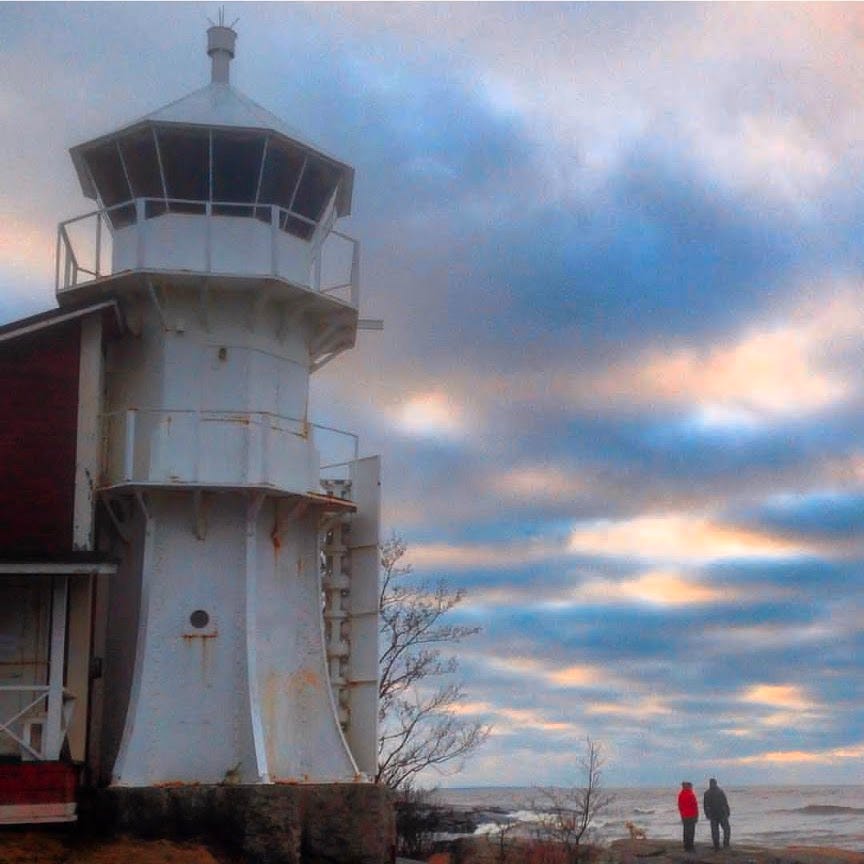
We stood together briefly, the three of us, at the edge of the water. The waves, tumbling together with the surface ice against the rocky shore, looked like Slush Puppie flavoured with cigarette ash.
Keijo leant in toward me and pointed to a stretch of shore toward the horizon. It was perfectly white with snow. That is Yyteri, he told me, Finland’s most famous beach. The Rolling Stones played there once, he said. Another solid bit of local trivia to add to the many he’d shared that week.
It’s about this point, wanting a closer look, I walked over to the lighthouse alone.
This is when I saw him. The man.
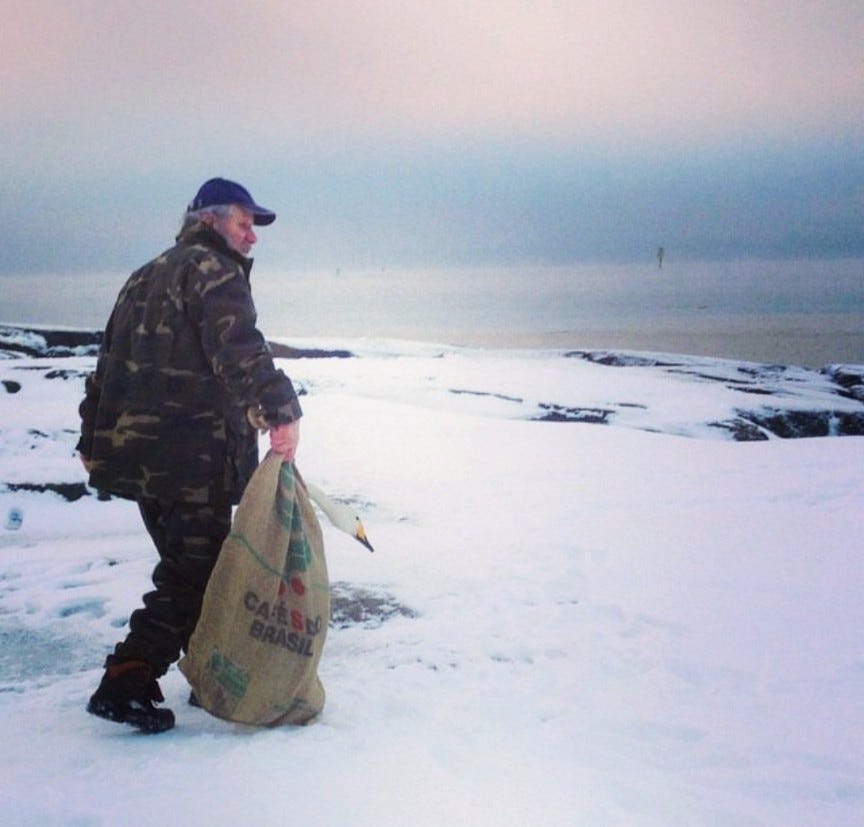
He announced himself with a cough that sounded like it had brought up a three-course meal into his mouth. Substantive. Walking from behind the lighthouse toward me, he wore a matching suit of forest camouflage, conspicuous against the snow, and an old blue baseball cap. In his hand he held a large brown sack. I squinted to get the glare from the snow out of my eyes. There was something about that sack I couldn’t quite work out. Though so very full, he seemed to be lugging it toward me with ease. And then, getting closer with every step he took, the picture coalesced into something that, almost, made sense.
Peeking out from his sack, coloured from perfect white to glaring yellow and ending in black, was the little bobbing head of a swan.
This couldn’t be good, I thought. A Finn making off with an actual swan? It certainly wasn’t what I expected from the Moomins book I’d read. I’d been led to believe Finns lived in perfect socialist harmony with the animals. I certainly didn’t expect to find the locals hauling innocent critters off in sacks for imminent consumption.
Stranger still, having soon caught my eye, he didn’t seem bothered by my presence at all. Not the slightest hint of shame or guilt at his now public evil. He chuckled something in my direction. A mix of vowels and Ks that I’ve now come to recognise as the soundscape of the Finnish language. And then he had the gall to casually walk on past me.
My heart was beating in my ear. It was on me, Wil Reidie of Camberley, Surrey, to step up and save the swan. Swans plural maybe. The bastard might have an illicit swan-poaching operation going for all I knew.
It was my moment.
I shuffled back toward Keijo and Silja. We have to do something, Keijo, I said. This can’t be good. I coyly gestured to the poacher with a nod of my head.
But Keijo didn’t respond. Only a slowly growing smile suggested he’d heard me at all.
Silja had stepped in front of me by this point, this being the only way I can make sense of my hiding behind her.
Then Keijo’s voice. He spoke calmly to the man, as though they were old friends. The man stopped. I could see the dirt under his fingernails. I thought briefly of how the swans all belong to the Queen and I had to remind myself that the Queen’s swan jurisdiction probably doesn’t extend to Finnish swans.
And then he started walking away.
Was Keijo going to let him get away with it? Was Silja? I wondered if I’d need to reevaluate these people I’d got myself in with. Could I really be the only one who cared about the Queen’s swans?
And that’s when Silja translated the conversation her father had just had for me.
No one was stealing any swans, she said.
There’d be no roast swan gracing the dinner table of a south-west Finland home tonight.
Having found the swan in distress while ice-fishing, the camouflaged man had merely taken it to clear its wings of impacted ice.
My ongoing journey toward better understanding Finnish people is coloured by stories like this. The day I met that potential swan kidnapper, I didn’t yet understand a single word.
By the time our second child was brewing within Silja a few years later, I’d taken a basic course in Finnish. I could say what I’d eaten for breakfast that morning, and could very nearly pronounce the Finnish word for bike properly.
I was on my way.
So on my way was I that I’d even started attempting to make jokes in Finnish. One such instance came at Silja’s first ultrasound. In that dark room, my wife relaxing with a mess of slime poured over her lower stomach, I kept my eyes away from the screen. I couldn’t bear to look, so nervous was I they’d find something wrong. I focused instead entirely on Silja, and the nurse’s words for anything I could understand. After much that I didn’t, there eventually came something I did.
“Täällä on pikkuaivot,” she said. Pikku aivot. Small brains. That means small brains.
I looked to the nurse. “Sama kuin hänen isä, sitten.” I replied.
Now, what I’d tried to do there, in response to the nurse mentioning “small brains”, was to say “same as their father”. Bless my little cringey English socks. A genuine joke. In Finnish. What a guy.
And then I looked to the nurse and saw from her entirely confused face that my attempt at humour had not landed at all.
“Don’t worry,” Silja said to the nurse, “he is trying to make a joke.”
Silja turned to me.
“Pikkuaivot means cerebellum in Finnish. Not literally small brains, Wil.”
The nurse finally smiled.
If there’s a reason I’ve been revisiting such stories of misunderstanding again it’s because I was back at my Finnish language course this week following the Christmas break.
This is the first time I’ve tried to learn a second language. And for all I can say and write and read, my ability to understand other people remains absolutely woeful. Finnish is just spoken so quickly. By the time I’ve made sense of the first words of a sentence, the end of the paragraph has already arrived.
I’ve read that multilingual people can think and even feel differently depending on the language they use. There’s evidence that colours are considered differently from language to language, the concept of time, even, as well.
In Finnish, I definitely become someone different.
I become someone who can’t listen.
On one level, so what? My Dad has been getting through life without listening to people for 70 years and he’s doing OK.
But, much as I love my old man, if there’s anything that has reaffirmed how important listening is to me, it’s being so bad at it in Finland. Listening is where learning comes from. It’s how we grow and love and understand.
After all, not all swans in sacks are destined for dinner.


The diary will continue next week…
Thanks for reading. You can support my work by becoming a paid subscriber, booking a cooking class with me, or buying my new ebook full of my most popular Nordic bun recipes. Check out the links below:
I absolutely love this series!!
That's some swan story! I am so glad no swans were hurt in making of this adventure. I am also amazed at the fact that the swan let the man help him; they are not always trusting and friendly.
Side question: do thoughtful medical professionals in Finland warm the sticky goo before the ultrasounds? Cause in its cold form it is VERY unpleasant for a second. :-)
Yeschef, your frustration is tender and palatable. I am ahead of you in the bilingual bihomeland journey, and I promise, it does get easier. Jokes, idioms, will all come to you in time. Though to be fair, I went from the "worse" language to learn (Polish) to the easier one... And my native English speaker kid corrects my English with gusto to this day... ;-)